Showing posts with label bulletin board. Show all posts

Friday, November 11, 2022

Kindergarten Flags for Veteran's Day


 My kindergarten students painted flags on 12"x18" paper this week in honor of Veteran's Day. They learned about the principle of art movement, and they learned the concept of "dot, dot, not a lot" while using "drippy glue" for the first time!

Before the students understood that they were gluing stars on, not painting their own, I had one very concerned looking kindergartner raise her hand and tell me worriedly, "but I don't know how to make a capital star yet!" Now I'm wondering what a lowercase star looks like, and if she knows how to make it! Her comment definitely made me chuckle.

Wednesday, August 12, 2020

"Welcome Back" Bulletin Board 2020

 What a different year we are starting out! I remember as we wrapped up online teaching in May, we all said we couldn't wait for things to be "normal" again in the fall! Well, now we are at the fall semester, and school starts tomorrow, and things are far less "normal" than they were in May. Our state governor has mandated masks for grades 3 (age 8) and up in Indiana. Here is my welcome back bulletin board, trying to shed a little humor on the difficult situation we are in! None of the Photoshop work is my own; I found all the art on Google.


Tuesday, August 7, 2018

Welcome Back Bulletin Board (2018)

School starts tomorrow! For my "welcome back" bulletin board, I recreated Starry Night out of paper.


Tuesday, December 12, 2017

December Famous Artist of the Month: M. C. Escher

I am excited for my students to be learning about M. C. Escher this month. He was an artist with a vivid imagination and amazing technical precision. It is interesting that he failed math in the school, as his artwork, especially his tessellations, are very mathematical in nature.


This text below M. C. Escher's photograph on the bulletin board reads:

M.C. Escher
Born: June 17, 1898
Died: March 27, 1972
Nationality: Netherlands
Art style: Tessellations; Op Art; Surreallism

Maurits Cornelis Escher was the youngest of 5 boys. He was raised by his father and his step mother. M.C. Escher’s father was a civil engineer, and engineering influenced his art.

M.C. Escher was a sickly child, and was drawn to music and creative endeavors. He was not good at math, and technically never graduated from high school, since he could not pass the final math exams.

After high school, M.C. Escher studied at the School for Architecture and Decorative Arts in Haarlem, Netherlands. He became interested in graphic design and woodblock printmaking.


Despite failing math in school, M.C. Escher’s art is characterized by mathematical precision, especially in his tessellations (designs where shapes interlock like puzzle pieces).

Wednesday, November 1, 2017

November Famous Artist of the Month: Pieter Bruegel the Elder

I am excited to feature Pieter Bruegel the Elder on my bulletin for this month!


The text on the bulletin board reads:

Pieter Bruegel the Elder
Born: 1525
Died: September 9, 1569
Nationality: Netherlands
Art style: Landscapes and Genre Painting

Pieter Bruegel the Elder lived so long ago that little is known about his family life. We do not even know what his birthday was.

Bruegel’s name was originally spelled “Brueghel”, but he dropped the ‘h’ in 1559, and started signing his art with a different spelling of his name.

Pieter Bruegel’s two sons, Pieter Brueghel the Younger, and Jan Brueghel the Elder, were also artists. He died when they were small children, so their grandma trained them.

Pieter Bruegel also had a daughter, but nothing is known about her.


Pieter Bruegel is known for landscapes and peasant scenes, which are called genre paintings. Genre paintings show normal people doing normal things.

Friday, October 20, 2017

October Famous Artist of the Month: Norman Rockwell

This month, I am featuring a much loved artist, Norman Rockwell! The students have been intrigued to learn about his career as a magazine illustrator. Even though most magazines today feature photography, not paintings, magazine design (with a graphic arts degree) is still a popular career!

Whenever art class ends a few minutes early, being able to discuss the art on my bulletin board has been a great way to use time effectively. I've also been able to knock off many state standards about looking at and understanding art with this bulletin board!


The text on my bulletin board reads as follows:

Norman Rockwell
Born: February 3, 1894
Died: November 8, 1978
Nationality: U.S.A.
Art style: Illustrations of American Culture

Norman Rockwell was born in New York City. At age 14, he transferred from high school to Chase Art School. He later attended the National Academy of Design and the Art Students League.

After completing his education, Rockwell got a job illustrating for Boys’ Life magazine, a publication of the Boy Scouts of America. For $50 a month, he had to design a cover illustration, and a set of story illustrations.


Rockwell later gained fame illustrating the cover of the Saturday Evening Post. His illustrations were whimsical interpretations of American life.

Monday, October 2, 2017

September Famous Artist of the Month: Claude Monet

Claude Monet was featured on my bulletin board last month! I just took him down today. All of the photos were from a calendar; I need to find more old art calendars!


The text under the photo reads:

Claude Monet
Born: November 14, 1849
Died: December 5, 1926
Nationality: France
Art style: Impressionism

Claude Monet enjoyed drawing even as a child. He first made money by drawing caricatures (cartoon-style pictures of people).

Claude Monet was 11 when he enrolled in an art school. His mother was happy that he wanted to be an artist, but his father was sad, because he wanted Claude to take over the family grocery store.

Claude Monet was one of the first artists to paint from life outside. He would take his paints with him to parks, gardens, and ponds. He would paint what he saw in front of him.


Claude Monet’s style of art is called Impressionism because he would paint a quick impression of a moment in time. He painted quickly before the scene in front of him changed.

Monday, December 14, 2015

4th Grade Paper Cutting Lesson

This is a lesson I've posted about before. It is based on artwork by M.C. Escher, and introduces the concept of negative and positive space, as well as negative/positive space reversal. One thing that is really awesome about this lesson is that there is no trash! Every single piece of paper that gets cut out of one side gets glued on the other side. With many other paper cutting lessons, the paper scraps all over the tables and floor take some time to clean up, but with this lesson, the only reason we would have any paper to recycle is if someone messes up and starts over.

Here are a few student examples.


This student created a car:


Another student noticed that when turned upside down, it looks like a cow face! Everyone thought that was pretty awesome.


This year, I put every single student's work on my bulletin board. I love how they look in a group! I think they look stronger together than individually.


Thursday, February 26, 2015

6th Grade Landscape Paintings

I've posted twice already this semester about my 6th grade students' acrylic landscape paintings on canvas. The last group just finished up this morning! I've put all the paintings on display in our school's hallway. I went through three boxes of thumb tacks....my thumb is very sore!


Friday, January 30, 2015

3rd Grade Art Bulletin Board

I cannot believe it's 100th day and I'm just finally putting up a bulletin board....where does time go? Honestly, I know where my time has been consumed; in previous years, I've spent several long afternoons a week in my classroom hours past dismissal, but this year I finally had to get a 3rd job, which takes nearly every afternoon I have left. When the cost of living keeps going up, and teacher salaries stay the same, it's hard to make ends meet! So, I got another waitress job at a new restaurant in town. This Saturday, I'm working at both my restaurant jobs....breakfast and lunch at Cracker Barrel, and dinner at my new job!

This bulletin board displays one of my favorite 3rd grade projects; negative space face vases! I explained the lesson in a post a few years ago. I absolutely love watercolor resist, so there are a few close-up photos to highlight some especially nice results from the technique.


Friday, January 24, 2014

1st Grade Snowflake Bulletin Board

After putting art on my bulletin board in the hallway, I often have trouble sorting all the pictures when I take them down! The students are required to put their name and class code on the back of all their art, but so many students forget one or the other; if there's no class code, I have to figure out which Lindsay or Payton it is; if they forgot both, the chances of them getting their art back becomes pretty slim!

This week, I tried something different: each 1st grade class had the same art assignment, but on a different color of paper. Then, when I take down my bulletin board, it will be easy to sort them. Also, the students will easily be able to pick out which ones are from their class! Here is this week's bulletin board:


Tuesday, January 14, 2014

3rd Grade Starry Night-Inspired Paintings

Starry Night is one of my favorite paintings to teach about! I think I have blogged about it every year since I started teaching; well, here we go again! :)

By the time we got to Starry Night this year, my students were already familiar with Van Gogh because we had already painted sunflowers. I began by talking about many elements and principles of art in the painting. I especially like to point out the contrast of warm-colored stars, moon, and lights in the windows of the buildings against the cool-colored sky and town, cloaked with the blueness of night. There is movement in the sky; it seems to be swirling! The element of line is very strong; everything is composed of brush strokes.

Then, the students got to paint their own version of the sky; I gave them lots of freedom this year, letting them paint it however they wanted. I showed my own example painting, which used dotted lines to emulate Van Gogh's brushstrokes, and I demonstrated on the blackboard how dotted lines can make a shooting star or a brightly shining star. But, after the demonstrations and ideas, they could paint in any way they wanted.

The second day, I began by giving each student a postcard of either a Van Gogh painting, or a Vermeer. I explained the stylistic differences, and had the students figure out who painted the picture they were given. Then, each student went up to the blackboard and attached their postcard with a magnet to either the Van Gogh side or the Vermeer side. Then we further discussed differences between the two artists that the students noticed as they saw the many postcards. After the postcard game, the students finished painting their sky.

The last day was for making the town. I had the students cut buildings and trees out of black construction paper. I know this doesn't quite match Van Gogh's town, but I like the effect of the black town silhouetted against a lively sky. I demonstrated many ways to make trees and houses, and fancy buildings. It is much easier to cut a square, triangle, and rectangle, than trying to cut out the shape of a house with a roof and chimney all at once.

Here are some finished results, as well as the bulletin board showing many of the paintings all together.


Look; it's the big dipper!


Wednesday, November 20, 2013

2nd Grade Shape Collages

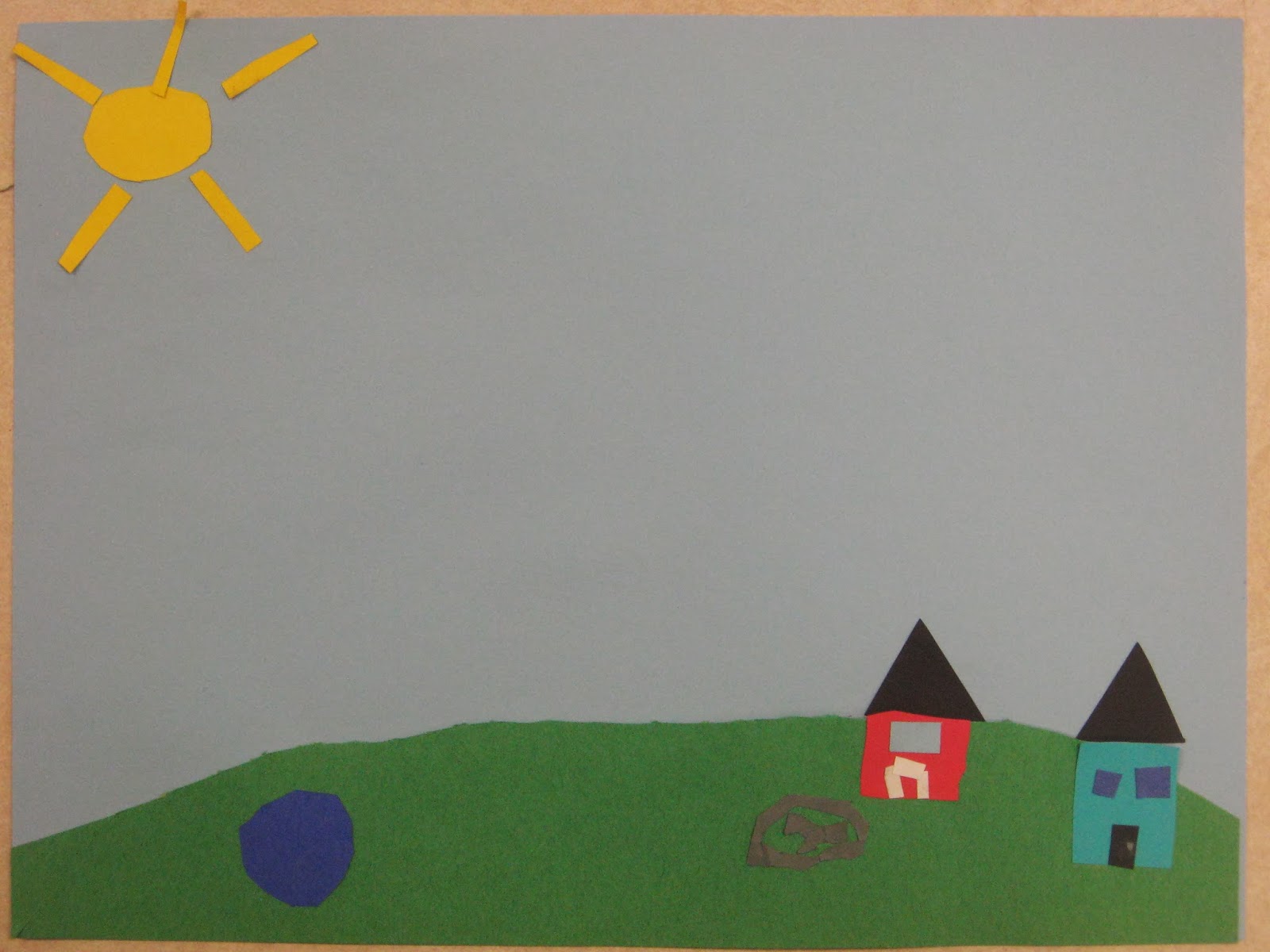
For the past two years, I have begun my 2nd grade students with a unit on line, and then shape. For the shape unit, one project is a collage of cut paper, in which the students learn the difference between free-form shapes and geometric shapes. They are required to use at least on of each in their collage.

This year, I had to postpone those two units in order to create art for Art To Remember, the fundraiser we did at the beginning of this school year. (The fundraiser went fantastically by the way; the parents loved the products, and we raised over $2,000 for art supplies!) So, I ended up doing shape collages with 2nd grade in the middle of November.

Well, those two months really made a difference; the students' collages turned out beautifully! Their art skills really are at a higher level now, than the previous classes were when they did this same assignment much earlier in the school year.

Here are some photos, followed by part of my bulletin board. I put every student's collage up, and they didn't all fit in the photo.