- Wish Upon A Paintbrush by Jackie Q. is a great blog full of creative ideas. Jackie is in her second year of teaching art after graduating in May 2011, just like me.
- Art With Mr. E by Ted Edinger is the first blog I ever started following. Mr. E is the Elementary Art Teacher of the Year in Tennessee, and is always full of great ideas, including his latest: a mixed media mural created by students in 5 different grades!
- Fru Billedkunst by Tina Kejlberg, an art teacher in Denmark, always has beautiful ideas. Because of my Swedish heritage, I can understand almost all of her posts (Swedish and Danish are similar languages). But, even if you can't understand what she writes, her pictures speak for themselves! Also, if you open her page in Chrome, there will be a "translate" option.
- Art Sub Lessons by Snippety Gibbet is a great resource for writing lessons for substitute teachers. Most of her posts are from other art teachers (a few from me!), so if you have a great sub lesson you'd like to share, I'm sure she will be happy to post it.
- Being Cr8iv by Jenni Ward is my favorite resource for clay projects. She has not posted since June, but her archives are full of great ideas that I have used in my own classroom, including what my 5th graders are currently working on (I'll post about it in a few weeks).
- Dream Painters by Elizabeth in Australia is a blog full of great ideas. Elizabeth is a self-employed after school art teacher, and her students always do beautiful work.
- Carol Marine's Painting A Day chronicles Carol's own work, as well as some painting workshops she teaches (for adults).

Thursday, November 22, 2012
Other Great Art Education Blogs
I finally added a blogroll of all of the blogs I am following on my page (scroll down; it's on the right below my followers). I get so many great ideas from other blogs, as well as from Pinterest (which often links back to another art teacher's blog!), so I'm going to share a little bit about a few of my favorites. All of the blogs I added have been wonderful resources for me, but I'm going to take a minute to just highlight a few:

Tuesday, November 20, 2012
How To Draw A Soccer Ball
Often students ask me how to draw a horse, or a basketball, or a frog, or SpongeBob. For most of these questions, I demonstrate on the chalkboard or on scrap paper. Sometimes I print a photo of the object for the student to look at while drawing. However, one things that the kids can never seem to draw, even if they have a photograph to look at, is a soccer ball! The little intersecting black pentagons and slightly larger white pentagons somehow always confuse children. So I recently developed a set of step-by-step instructions to draw a simple soccer ball that only requires the artist to draw one pentagon free-hand. I tell the kids it's like a house whose walls are leaning outward a little. I thought I would share it on here in case if anyone else needs an easy way to teach elementary kids to draw a soccer ball.

Monday, November 19, 2012
Third Grade Wayne Thiebaud Cupcakes
My 3rd grade students recently looked at some artwork by Wayne Thiebaud. The students noticed that he used light, medium, and dark values to create light and shadows in his artwork. Then, the students mixed different values of brown and a color of their choice to make cupcakes. After painting the light, medium, and dark parts of the cupcakes, I showed the students how they could blend the colors with their finger to make a smoother transition between sections.


Thursday, November 15, 2012
4th Grade "Batik" Pumpkins
My 4th grade students are currently learning about value. Right now, we are mixing different tints and shades with tempera (I'll post about it in a few weeks). Last month, I introduced the concept, and we made value pumpkins with crayons. The students used different values of orange to make the pumpkins look round. Then, we wrinkled them up (the kids loved that part!), smoothed them out, and painted over the whole picture with watered down black tempera paint. We dabbed the pumpkins clean with paper towels (it was messy!) and here are a few of the finished results. Some students colored the background as well, but I forgot to take pictures before they took them home:


Friday, November 9, 2012
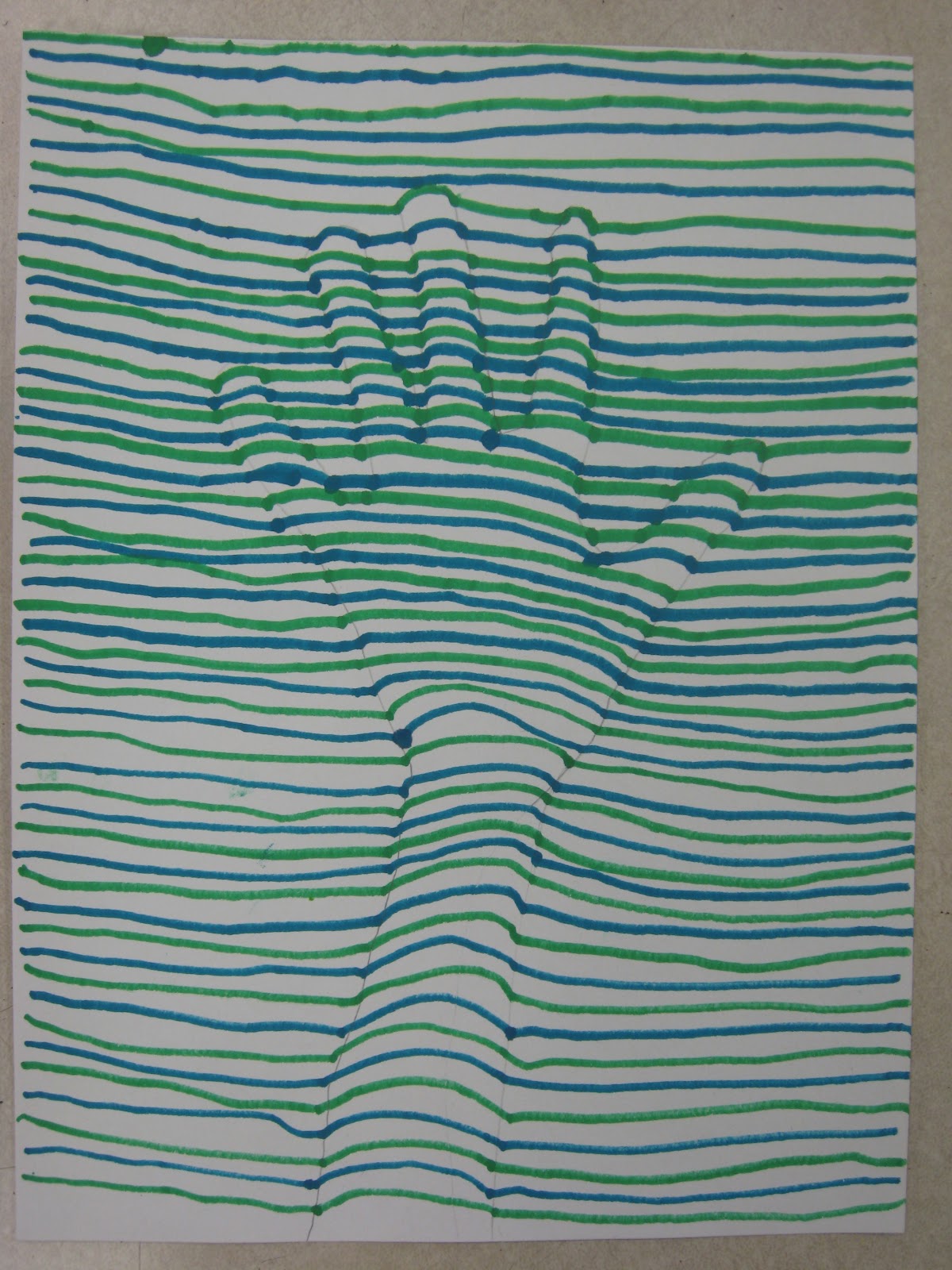
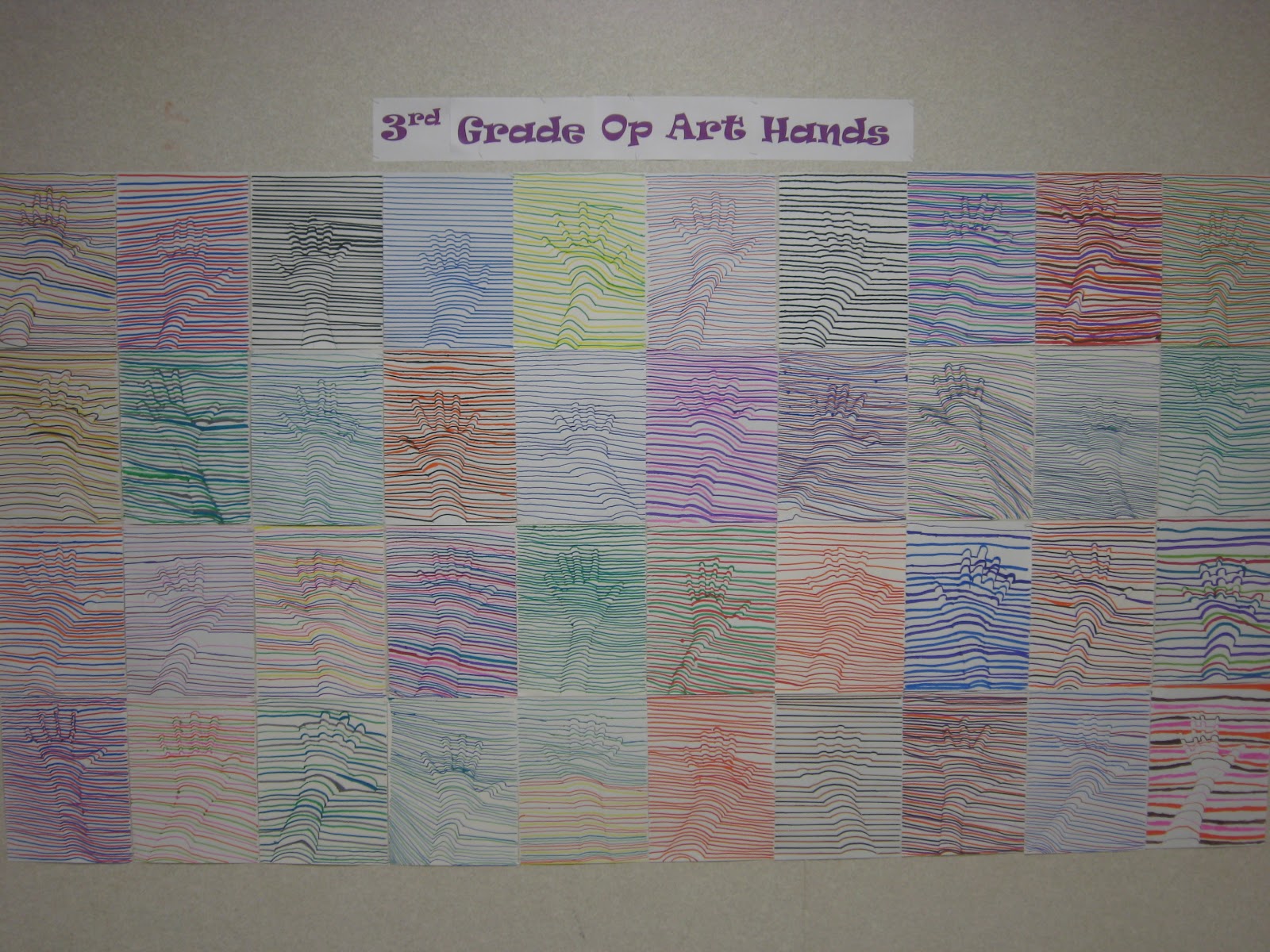
3rd Grade Op Art Hands
My 3rd grade students recently studied the artwork of Bridget Riley and Julian Stañczak. After learning about those artists, my students made their own Op Art-inspired artwork. I have seen this idea on Pinterest and other websites and blogs, so I'm not sure whose idea it was originally. We began this project by tracing our hands lightly (so the pencil marks can later be erased). Then, the students drew straight lines across their paper with markers, but whenever they got to a finger, thumb, wrist, or other part of their hand, they would make a rainbow line. The trickiest part for the students was making four rainbow lines in a row at the fingers, and then switching to one large rainbow line where the fingers attach to the hand.


I love the way these all look in the hallway! As I was hanging my bulletin board today, several students stopped in the hallway and said, "wow, those are cool!" and some asked how to do it. Then, our school secretary stopped and told me that one of the 3rd graders has been in detention lately, and she has been drawing an Op Art hand on her own in detention! I'm glad to know that my students are practicing their art skills outside of my room, even if it is in the detention room :).
Pretty Purple Flowers
Every week, I pick a student to be “Artist of the Week.”
Someone who did an extra nice job in art class will get their artwork displayed in
the glass case near the entrance of our school. Usually the “Artist of the Week”
is someone who followed directions really well, was creative, and had wonderful
craftsmanship and great attention to details. In a very structured art lesson,
sometimes it is difficult to choose between similar pictures; in a less
structured lesson with more freedom, sometimes it’s hard to choose between
pictures that are very different and brilliant in different ways!

This week, 1st grade did an art project with a lot of room for creativity. This is the point where the difference between talented students and kids who are struggling becomes apparent! My 1st graders have been learning about secondary colors, and each week, we mixed a different color to make a new picture. This week we did purple, and the assignment was the draw the flower stems and any details with crayons, and to paint the petals with purple paint that we mixed from red and blue.
Some students made flowers in a garden. Others put their flowers in a bouquet. Some students put their flowers in a vase or flower pot. With lots of variety, there were many nice pieces of artwork. But, this week, one student really stood out to me.
This little girl used creativity to color the wall behind the flowers with the side of the crayon, giving it beautiful texture. She also used a great analogous color scheme. Different shades of blue, blue-violet, violet, and red-violet appear throughout the picture. And, she didn't leave anything white that shouldn't be white! Wow. I am very impressed.

Monday, November 5, 2012
Perspective with 6th Grade
My 6th grade students recently studied Da Vinci's The Last Supper. We talked about why the painting had become so famous. Other artists had painted the same subject before him; other artists were good at painting people. But, the painting became so famous because Da Vinci created the illusion of a real room (instead of just a flat wall). He used one-point perspective to do this.
I used my Promethean board to trace all of the converging lines to the vanishing point, which is just above Jesus's head. I think Da Vinci purposely made a striped carpet and checkered ceiling to add more converging lines!

The students were very excited to see this! For those of you who also teach K-6, you know how 6th grader's attitudes are, so I was very happy to be able to impress them.
Next, we looked at some photographs with converging lines on them. We looked at a picture of some railroad tracks, and an aerial view of a city. This time, I let the students find the converging lines. We traced them until we got to the vanishing point. In the city photograph, the vanishing point was off the edge of the page.


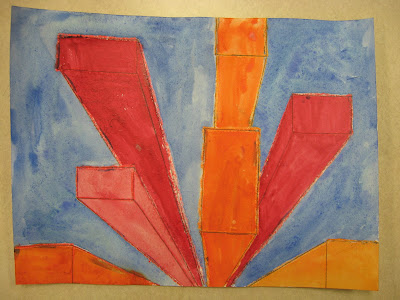
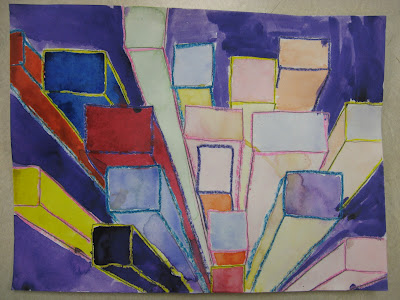
Next, the students made their own perspective pictures of an aerial view of a city. I let the students choose if they wanted to make a realistic city, with details such as windows on the buildings, or if they wanted to make an abstract city that was basically colored 3-D boxes. If the students wanted their vanishing point to be off of the edge of the page, we attached a Post-It note to the edge of the paper, and drew the dot on that. The students used crayons for small details and lines, and painted large areas with watercolors. Here are some student examples:





I used my Promethean board to trace all of the converging lines to the vanishing point, which is just above Jesus's head. I think Da Vinci purposely made a striped carpet and checkered ceiling to add more converging lines!

The students were very excited to see this! For those of you who also teach K-6, you know how 6th grader's attitudes are, so I was very happy to be able to impress them.
Next, we looked at some photographs with converging lines on them. We looked at a picture of some railroad tracks, and an aerial view of a city. This time, I let the students find the converging lines. We traced them until we got to the vanishing point. In the city photograph, the vanishing point was off the edge of the page.


Next, the students made their own perspective pictures of an aerial view of a city. I let the students choose if they wanted to make a realistic city, with details such as windows on the buildings, or if they wanted to make an abstract city that was basically colored 3-D boxes. If the students wanted their vanishing point to be off of the edge of the page, we attached a Post-It note to the edge of the paper, and drew the dot on that. The students used crayons for small details and lines, and painted large areas with watercolors. Here are some student examples:


Subscribe to:
Posts (Atom)